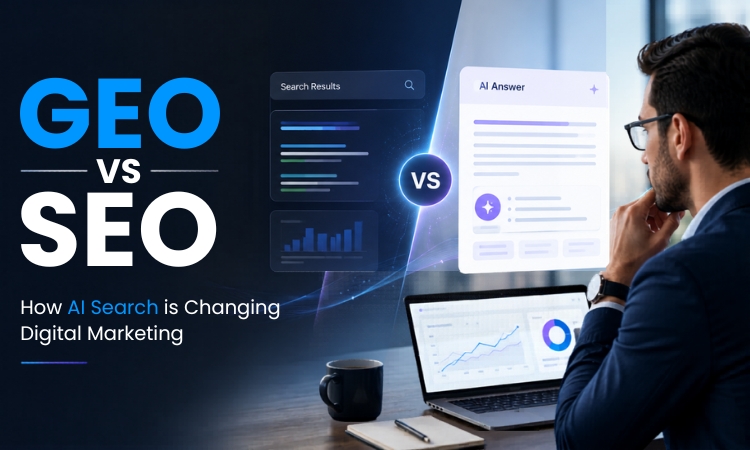
GEO vs SEO: How AI Search is Changing Digital Marketing
Get In Touch

A lot of people in digital marketing are quietly realising the same thing right now: search does not work the way it used to anymore. A few years back, SEO was mostly about rankings. You pick keywords, optimise pages, build backlinks, and try your best to reach page one on Google. That was the game. And for a long time, it worked pretty well. But now? Things feel different.
People are searching differently. AI tools are answering questions directly. Users are spending more time on platforms like OpenAI ChatGPT, Perplexity AI, and AI search experiences instead of clicking ten blue links like before. Even Google’s AI Overviews are changing what search results look like. That is exactly why the whole GEO vs SEO debate has suddenly become important.
Businesses are now realising that ranking on Google alone may not be enough anymore. You also need your content to appear inside AI-generated answers. And that is where GEO marketing enters the picture.
In this guide, we’ll talk about the difference between GEO and SEO, why AI search optimisation is becoming a real thing in 2026, and why smart businesses are slowly starting to combine both instead of treating them like competitors.
Also Read: How to Rank #1 on Google
What is GEO (Generative Engine Optimisation)?
GEO stands for Generative Engine Optimisation. It sounds fancy at first, but the concept is actually pretty simple. Instead of optimising only for search engine rankings, GEO focuses on making your content visible inside AI-generated responses.
For example, when someone asks an AI tool a question, the system pulls information from multiple sources and creates an answer. GEO marketing tries to increase the chances of your content becoming part of that answer.
So while SEO focuses heavily on rankings and clicks, GEO focuses more on AI visibility and citations. That is one of the biggest differences between GEO and SEO. And honestly, this shift is happening much faster than many marketers expected.
A lot of users now prefer asking conversational questions to AI systems instead of typing robotic search queries into Google. You can already see this behaviour changing.
Earlier people searched:
- “Best laptops for students”
Now they ask:
- “What’s a good laptop for a college student who edits videos but also wants good battery life?”
AI search handles those conversations much better than traditional search engines. That is why AI search optimisation is becoming such a big topic right now.
What is SEO?
SEO, or Search Engine Optimisation, is basically the process of improving your website so it ranks higher on search engines. Simple enough. The idea behind SEO has always been pretty straightforward. If your page appears higher in search results, more people see it, more people click it, and ideally, more people become customers.
That is why businesses spend years working on:
- content
- backlinks
- technical SEO
- internal linking
- page speed
- keyword optimisation
But, SEO is still incredibly important. People still search for things every single day. Someone wants the “best running shoes,” someone else is looking for “best CRM for startups,” and another person is searching “how to write SEO content.” SEO helps your website appear when those searches happen.
But here’s the thing people are slowly noticing now. Users are not always clicking websites anymore. Sometimes AI tools answer the query before users even visit a page. That changes the entire search journey. And that’s exactly why the SEO in AI era looks very different compared to traditional search marketing.
GEO vs SEO: Key Differences
The easiest way to understand GEO vs traditional SEO is this:
SEO tries to help your website rank. GEO tries to help your content get referenced.
Traditional SEO mainly cares about things like:
- Rankings
- Traffic
- Clicks
- Impressions
- Keyword positions
GEO looks at different signals. AI systems care more about:
- Clarity
- Trustworthiness
- Topical depth
- Conversational relevance
- Structured information
- Authority
This is why some websites with massive traffic are still struggling to appear in AI-generated answers, while smaller but highly trusted sources sometimes get cited repeatedly. AI systems are not only looking for keywords anymore. They are trying to understand expertise. That changes content strategy a lot.
Here’s a table to make it clearer for you:
Factor | SEO | GEO |
Main Goal | Rank on search engines | Appear in AI-generated answers |
Focus | Keywords and rankings | AI citations and contextual relevance |
Traffic Source | Organic clicks | AI visibility and mentions |
optimisation Style | Search engine algorithms | Generative AI systems |
Content Format | Search-focused | Conversational and contextual |
Success Metric | Rankings and traffic | AI references and visibility |
User Journey | Click-based | Answer-based |
Strategy | Technical + content SEO | Authority + AI readability |
SEO Focuses on Rankings
Traditional SEO is still heavily tied to rankings. Most SEO campaigns are built around improving visibility on search engine result pages. You identify keywords, optimise content around them, and try to outrank competitors.
That approach still works. In fact, strong SEO foundations are probably more important than ever because AI systems still rely on web content for information.
Without good SEO, your content may not even get discovered properly. So no, SEO is definitely not dead like some people on LinkedIn keep shouting every six months.
GEO Focuses on AI Citations
GEO works differently. Instead of asking:
- “How do I rank number one?”
The question becomes:
- “How do I become a trusted source AI systems want to reference?”
That changes how content gets written. Suddenly, shallow blogs written only to stuff keywords start performing worse. Generic AI-generated articles with zero original thinking also become less useful.
AI systems seem to prefer content that feels:
- Helpful
- Specific
- Trustworthy
- Experience-driven
And that makes sense. If AI engines are summarising information for users directly, they need reliable sources behind those answers.
Why GEO is Becoming Important in 2026
The rise of AI search is probably the biggest reason GEO marketing is growing so quickly. People are already using AI tools like search engines now. And not casually either. For many users, it is becoming a daily habit.
At the same time, organic clicks are getting weird. A lot of websites are seeing impressions rise while clicks drop. Why? Because users are getting answers directly from AI summaries and Google AI Overviews without needing to visit websites.
That changes traffic patterns completely. Businesses ignoring this shift right now may struggle later. Another huge reason GEO vs SEO discussions are increasing is because search behaviour itself feels more conversational now.
Search is slowly becoming less keyword-focused and more intent-focused. People talk to AI systems almost like they’re chatting with another person. That means content written in a stiff, robotic SEO style feels outdated much faster now.
How SEO and GEO Work Together
One mistake people make is treating SEO and GEO like rivals. They are not. In reality, they support each other.
SEO helps search engines discover your content properly. GEO helps AI systems understand and trust it. Without technical SEO, your pages may not get indexed efficiently. Without GEO-friendly content, AI systems may ignore your website while generating answers.
The businesses doing well right now are usually combining both. They still follow Best SEO Practices. They still care about backlinks, page speed, and keyword targeting. But at the same time, they are also creating content that sounds natural, structured, and genuinely useful. That combination matters a lot.
Best Practices for SEO in the AI Era
Here are some best practices for SEO that you need to follow:
- Continue Building Strong Technical SEO
Technical SEO still matters too. Fast websites, proper site structure, internal linking, schema markup, all of that still helps.
- Create High-Quality Content
One thing that definitely has not changed is the importance of good content. Not “SEO content” written only for algorithms. Actual useful content. Content that explains things clearly. Content that feels like a real person wrote it. Content that solves a problem instead of stretching a topic to hit word count. This human-focused approach is becoming even more valuable in the future of AI in SEO.
- Build Authority Through Backlinks
Backlinks also continue to matter because authority still matters online. Trusted websites tend to get trusted more by both search engines and AI systems. So if someone says SEO no longer matters because of AI, that’s just an oversimplification. The real shift is that weak SEO tactics are dying faster now.
Best Practices for GEO Optimisation
Here are some best practices for GEO optimisation:
- Write Conversational Content
GEO optimisation feels more human in many ways. The content that performs well for AI search optimisation usually sounds conversational and natural. It explains ideas clearly without trying too hard to impress.
- Use Clear Content Structure
AI systems seem to process well-organized content more easily. Clean headings, logical flow, short readable paragraphs, and direct explanations all help.
- Build Topical Authority
If your website randomly jumps between unrelated topics all the time, AI systems may not fully trust your expertise. But if you consistently publish strong content around one subject, your authority grows. This is especially important for businesses like an SEO agency in india or SaaS companies competing in crowded markets.
- Add First-Party Insights and Data
Generic AI-written content is flooding the internet already. Everybody can generate surface-level blogs now. What stands out are things like:
- Real case studies
- First-party data
- Expert opinions
- Original research
- Actual experiences
That human layer is becoming a competitive advantage.
GEO vs SEO: Which One Should Businesses Focus On?
Businesses need both. Small businesses should still prioritise strong SEO foundations because search traffic still drives real customers. Ignoring traditional SEO completely would be a mistake.
But adding GEO marketing strategies early is smart too because AI search is clearly growing.
For competitive industries, GEO may become even more important over time because AI visibility could eventually influence brand trust and awareness heavily.
The smartest approach right now is probably balance. Build search visibility through SEO while also building AI visibility through GEO. That feels like the safest future-proof digital marketing strategy at the moment and helps businesses maximise the Benefits Of Digital Marketing in the long run.
Common Mistakes to Avoid
Here are some common mistakes that every SEO-marketer needs to avoid:
- Ignoring AI search trends
One of the biggest mistakes businesses are making right now is pretending AI search trends are temporary. They are not.
- Over-optimising content for keywords.
Don’t over-optimise your content so aggressively that it stops sounding human. You can almost immediately tell when an article was written only to rank instead of help.
- Thin AI-generated content
A lot of websites are mass-publishing generic blogs with no expertise behind them. That strategy may work short term, but long term it feels risky.
- Ignoring authority, trust, and authenticity
They still and will always matter when it comes to SEO.
- Not focusing on user experience
Even the best content struggles if the website is slow, cluttered, or frustrating to navigate.
The Future of Search: SEO + GEO
Search is becoming more conversational. That shift already feels obvious. People are asking longer questions. AI systems are giving summarised answers. Search engines are slowly becoming answer engines.
And weirdly enough, as AI grows, human expertise becomes even more valuable. That part surprises a lot of people.
But it makes sense when you think about it. If AI can generate average content instantly, then original thinking, credibility, authenticity, and real experience become the things that actually stand out.
Trusted brand signals will probably matter even more in the future. Strong reputation, expert-backed content, authoritative mentions, all of these influence whether AI systems trust your information enough to reference it.
Businesses that adapt early will likely gain a major advantage. That’s why the GEO vs SEO discussion matters so much now. It’s not about replacing SEO. It’s about understanding that search itself is evolving.
Conclusion
The biggest mistake businesses can make right now is thinking this is just another short-term marketing trend. AI search is changing how people discover information online — slowly in some industries, and very quickly in others. Traditional SEO still matters massively. Rankings, technical optimisation, backlinks, and discoverability are not disappearing anytime soon, especially for any growing SEO agency in India focused on long-term online visibility.
But GEO marketing is becoming important because visibility now goes beyond search result pages. Brands also need visibility inside AI-generated answers. That is really what GEO vs SEO comes down to. One helps you rank. The other helps you become part of the answer.
And the businesses that learn how to combine both early will probably have the strongest advantage in the next phase of digital marketing.

Pranav Jha
Pranav Jha is the Founder and Director of AP Web World, a Google Partner Agency. With over 13 years of experience in digital marketing, he specializes in SEO, Google Ads, and result-focused strategies. On the AP Web World blog, Pranav shares easy-to-follow insights on SEO, AI tools, and the latest trends, helping businesses and marketers grow in today’s fast-changing digital world.