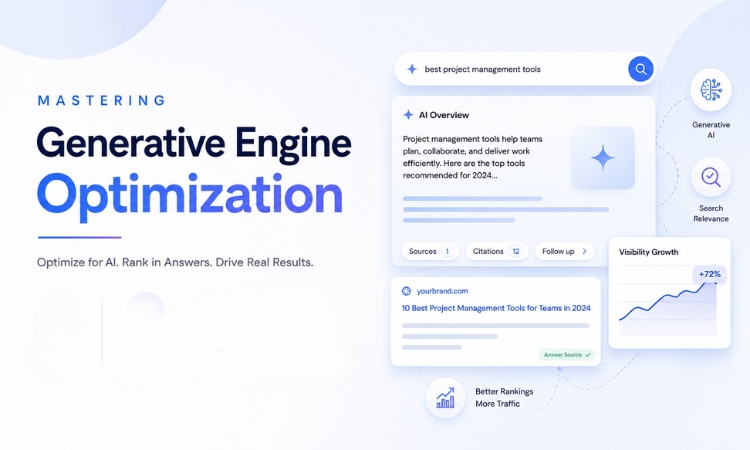
Mastering Generative Engine Optimization (GEO) for 2026 AI Search Dominance
Get In Touch
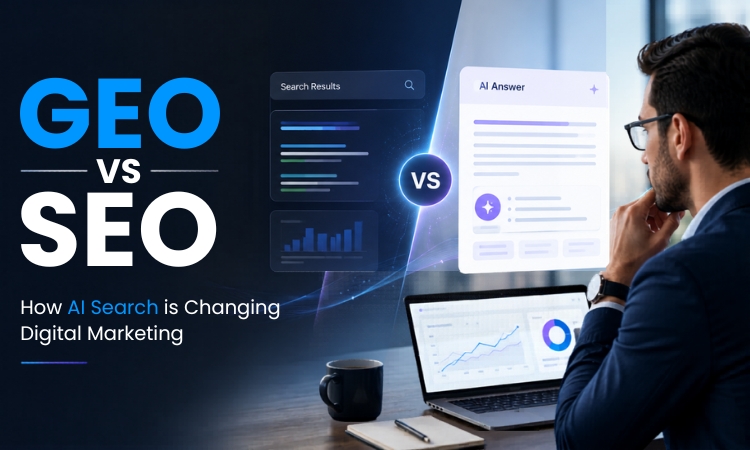

Search as we knew it is quietly fading into the background. Blue links are still there, but they’re no longer the star of the show.
Nearly 60 % of Google searches on mobile devices now end without the user clicking through to a website, largely due to AI-generated summaries and instant answers.
Today, people ask questions and get direct answers from AI tools instead of scrolling through ten results and clicking around. In 2026, this shift isn’t a trend; it’s the default.
This is where GEO optimization 2026 comes into play.
As AI-generated answers dominate search experiences, brands are no longer competing just for rankings. They’re competing for recognition, citations, and mentions inside AI responses. If your brand isn’t being referenced by AI systems, your visibility drops, even if your traditional SEO looks “fine” on paper.
That’s why generative engine optimization has become essential for maintaining AI search visibility 2026 and beyond. GEO helps brands stay discoverable in a world where AI summarizes, filters, and recommends information before users ever see a website.
This guide breaks down what GEO really is, how AI engines decide who gets cited, and how you can build sustainable visibility in AI-driven search, without keyword stuffing or chasing gimmicks.
What Is Generative Engine Optimization (GEO)?
At its core, generative engine optimization is the practice of optimizing your digital presence so AI systems can understand, trust, and reference your brand in their responses.
Traditional SEO focuses on ranking web pages. Answer Engine Optimization (AEO) focuses on featured snippets and voice search.
GEO strategies, however, focus on something slightly different:
- Being selected as a reliable source by generative AI engines.
Instead of asking, “How do we rank #1 on Google?” GEO asks:
- Will AI systems recognize us as an authority?
- Is our content structured in a way AI can easily parse?
- Do we deserve to be cited when an AI answers this question?
GEO doesn’t replace SEO; it builds on it. But the goal shifts from traffic alone to influence within AI-generated answers.
How AI Engines Choose Which Brand to Cite
AI engines do not select brands randomly. Instead, they follow patterns, but these are not patterns we are used to in traditional search engines.
Authority Signs
AI engines prefer brands that have shown their authority over time. This includes publishing, being mentioned by other authoritative sources, and having consistency across platforms. While similar to SEO, it is much more holistic.
Entity Trust
AI engines are entity-based, not page-based. This means that if your brand, you, or your products are consistently associated with one particular topic, AI engines will eventually learn to trust you.
Content Clarity
The best content is clear, concise, and written in a logical manner. AI engines prefer to crawl content that does not require them to overthink every word to understand it.
This is where ChatGPT citations SEO and Perplexity optimization come into play. These platforms will favor content that:
- Is direct to questions
- Does not overcomplicate things
- Has verifiable data and explanations
In other words, AI engines will prefer to cite brands that teach, not brands that over-optimize.
Core GEO Ranking Factors in 2026
GEO is affected by several overlapping factors. Here are some of the most important factors affecting GEO in 2026.
E-E-A-T Optimization
As mentioned earlier, E-E-A-T is at the core of every GEO strategy. AI engines check:
- Do you have experience?
- Are you an expert?
- Do you have authority?
- Do you have trust?
Some practical examples of how to implement these:
- In-depth author bios
- Editorial policies
- Links to other sources
- Transparent business information
AI does not just read what you write; it also assesses who wrote what.
Structured Data & Entity Markup
Structured data helps AI understand context in an instant.
Schema markup:
- Helps AI understand what your content is about
- Helps AI associate your brand with a specific topic
- Increases machine readability
While using schema markup does not guarantee a citation, it significantly improves visibility and understanding, especially on complex topics.
First-Party Data Signals
Original information is like gold in GEO.
AI algorithms are highly inclined towards:
- Proprietary research
- Case studies
- Surveys
- Industry benchmarks
Why? Because original information, as a data source, cannot be easily copied, AI considers original information more reliable. When AI needs information, such as statistics or examples, it prefers sources that publish original information rather than using commonly available information.
Content Freshness
AI prefers content that reflects current realities.
Fresh content, updated timestamps, and updated examples are all important. Content that has not been updated in years, even if it currently ranks well, becomes irrelevant in AI-generated replies.
Brand Mentions
Mentions are important, even without links.
Digital PR, podcast mentions, quotes, and features are all important in establishing brand credibility. AI uses mentions as a way of establishing brand credibility, helping AI understand that your brand is part of credible conversations in a specific niche.
GEO Content Framework for AI Search Visibility
GEO visibility is not something you can achieve by writing a single blog post. It’s a whole process where you have to create a content ecosystem that AI can understand and navigate with confidence.
Pillar Content
In-depth, original content that comprehensively discusses a core topic. Pillar content helps AI understand what you are all about.
FAQ Clusters
AI thrives on questions and answers. FAQs are important in helping AI understand what you are all about.
How-To Guides
The step-by-step nature of these guides lends itself well to reuse in AI-generated answers, making them very useful for answer-based queries.
Statistics & Data Pages
Having specific pages for important statistical information helps these AI systems more easily cite your brand for relevant data-based queries.
When these elements work together well, they help reinforce your brand’s authority and improve your visibility in AI-based searches in 2026 for various query types.
Optimizing for ChatGPT, Perplexity & Gemini
Each of these AI systems has slightly different requirements, though there are some similarities between them.
Citation-Friendly Formatting
Use these things:
- Easy-to-read headings
- Simple, direct paragraphs
- Bullet points
- Easy-to-understand explanations
This structure will improve your odds of being chosen as a source for these AI systems.
Also Read – Social Media Optimization Checklist 2026
Source-Worthy Content Structure
Consider these three questions when structuring your content:
- Does this answer a question clearly and honestly?
- Would I use this as a resource myself?
- Does it provide context, or just assert something as true?
The key to these systems is finding well-structured and well-written content that stands confidently on its own.
Zero-Click AI Search Strategy
Nobody measures success based on clicks alone these days.
With zero-click AI-based search results, users no longer need to visit your site to know about your brand. While this may be disheartening, there is an opportunity for increased visibility:
Winning zero-click visibility means:
- Your brand name is included in the results
- You are remembered as a trusted brand.
- You affect their decision-making process.
You may not be getting clicks, but with zero-click visibility, you gain brand equity.
Also Read – Local SEO in the Age of AI: How Indian Service Businesses Can Dominate City‑Level Searches in 2026
GEO Implementation Roadmap
GEO doesn’t work if it stays on slides or strategy docs. It only works when you actually do the work. This is what execution looks like.
Step 1: GEO Audit
First, figure out where you stand. Check if AI tools already mention your brand anywhere. Look at your content honestly, does it sound useful, or just optimized? If AI had to explain your topic, would it trust you as a source?
Step 2: Entity Optimization
Make your brand easy to understand. Your website, author pages, and external mentions should all tell the same story about who you are and what you’re known for. If things feel scattered, AI will get confused too.
Step 3: Content Restructuring
You don’t need 50 new blogs. Fix what you already have. Make content clearer, tighter, and easier to scan. Cut fluff. Add context noticed only by humans, and AI understands it better too.
Step 4: Schema Implementation
Help machines read your site properly. Structured data gives AI extra clarity about your pages, your brand, and how everything connects. It’s not exciting, but it matters.
Step 5: Digital PR
AI trusts brands that others talk about. Get mentioned on relevant sites. Be quoted. Show up in podcasts, reports, and industry conversations. Even without links, these mentions build credibility.
Step 6: Tracking & Iteration
GEO isn’t a one-time fix. Watch where your brand shows up in AI answers. Track citations, mentions, and patterns. Adjust. Repeat. This is ongoing work, not a set-and-forget thing.
Why AP Web World for GEO Services
GEO needs a different way of thinking. Not hacks. Not shortcuts.
AP Web World works with an AI-first mindset. The focus isn’t chasing algorithms; it’s building authority that AI engines naturally rely on when answering questions.
What makes the difference:
- Real understanding of how generative search actually works
- Hands-on experience with GEO, not just theor
- Strategies built around your industry, not generic templates
This is about playing the long game and being visible where it actually matters.
Conclusion: Preparing for the Future of AI Search
Search isn’t about ranking positions anymore. It’s about whether AI mentions you at all.
GEO optimization 2026 is no longer optional if you want to stay visible. As AI continues to control how information is discovered, brands that are clear, credible, and genuinely helpful will win.
Generative engine optimization shifts the goal from chasing clicks to earning trust, from both AI systems and real people.
If you want your brand to still matter in AI search a year from now, the time to act is now.
Ready to Take the Next Step? Request a GEO Readiness Assessment and find out how prepared your brand is for AI-driven search dominance.

Pranav Jha
Pranav Jha is the Founder and Director of AP Web World, a Google Partner Agency. With over 13 years of experience in digital marketing, he specializes in SEO, Google Ads, and result-focused strategies. On the AP Web World blog, Pranav shares easy-to-follow insights on SEO, AI tools, and the latest trends, helping businesses and marketers grow in today’s fast-changing digital world.